Diatribe on a variety of topics, attempting to link science, faith and philosophy, as well as discussion on pedagogy, blended learning and Web 2.0.
Erstaunen bin ich da.
Showing posts with label prayer. Show all posts
Thursday, October 11, 2012
Haven't got a prayer?
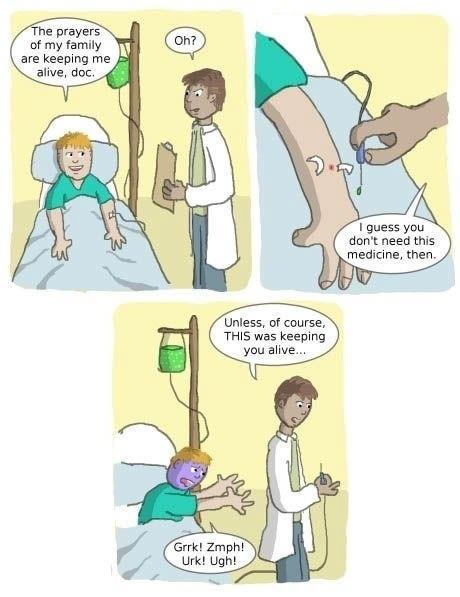
When I first saw this cartoon, my reaction was one of, ok, another friend on Facebook playing the smart ass atheist. Let's have a shot at Christians believing the fantasy of prayer - the separation of the noumenal from the phenomenal. Upon reflection, while the intent of the cartoon and the sharer may be that, it provides us with an opportunity to reflect upon the nature of prayer.
Christians believe in a God that gets involved with the universe. Humble Christians don't pretend to fully understand how it works. Humble atheists might appreciate that we can't understand fully how the universe works with or without God. But mystery is no excuse for intellectual laziness, so here goes a very short attempt at thinking about prayer.
Firstly, given that God is personal, prayer is not magic. It's not about simple manipulation to get results. If someone prays for healing and they are not healed, it is hard, a mystery, but it happens and we will never know why (unless you believe either God does not exist or that prayer doesn't change God's pre-ordained will).
Secondly, while miraculous healings occur (at least events that have been recorded may be interpreted as so inside a theistic framework); medical science and prayer are not opposed as in the strawman cartoon above. There have been some tragic cases in the media where they have been opposed by Christians and people have died; but there is no firm biblical warrant to back such irresponsible behaviour up. Paul had a physician and yet no doubt prayer. His thorn in the flesh may have been an issue with eyesight, we don't know. The only reference I know of that is antagonistic is in 2 Chronicles, where Asa is criticised for seeking physicians rather than the Lord. We need to keep in mind he was not pursuing medicine in any way we'd understand it but the equivalent of black magic.
Finally, God upholds all things - this is the doctrine of providential care. In a sense we are all kept alive by God, whether we pray or not.
So prayer is never a substitute for seeking health care through the wisdom and knowledge of doctors who, whether they acknowledge it or not, gain this from the great physician.
Tuesday, May 29, 2007
A Night Hymn of St. Gregory Nazianzus (the Theologian)
I thought this was great - here's my 100th post.
O Christ, Word of God
light of light, without beginning,
help of the Spirit,
we praise You.
Threefold light of one undivided glory,
we praise You.
You have banished the darkness and created the light
and in this You have created all things.
To Matter You have given life
giving it the imprint of the face of the world
and the traits of its beauty.
You have illumined man’s spirit
with reason and wisdom.
Your eternal light is reflected everywhere,
so that in the light, man might discover
true beauty, and all become luminous.
You have lit up the heavens with variegated lights.
The night and the day You have commanded to take turns
in a rule of fraternal friendship;
The first brings to an end the fatigue of the body,
and the other spurs us on to work as commanded;
And we flee from the darkness
to hasten towards that day
which no sadness of the night
can ever bring to an end.
Give to my eyelids a light slumber
that my voice may not long remain silent.
While created things watch to sing psalms with the angels,
may my sleep be ever restful in your presence;
May the night make me oblivious of the day’s sins,
and its oddities not beset my dreams.
Even if my body is inert
my spirit, O God, gives You praise!
Father, Son and Holy Spirit,
to You be honor and glory and power
through all ages. Amen
Patrologia Graeca 27. 311-314
O Christ, Word of God
light of light, without beginning,
help of the Spirit,
we praise You.
Threefold light of one undivided glory,
we praise You.
You have banished the darkness and created the light
and in this You have created all things.
To Matter You have given life
giving it the imprint of the face of the world
and the traits of its beauty.
You have illumined man’s spirit
with reason and wisdom.
Your eternal light is reflected everywhere,
so that in the light, man might discover
true beauty, and all become luminous.
You have lit up the heavens with variegated lights.
The night and the day You have commanded to take turns
in a rule of fraternal friendship;
The first brings to an end the fatigue of the body,
and the other spurs us on to work as commanded;
And we flee from the darkness
to hasten towards that day
which no sadness of the night
can ever bring to an end.
Give to my eyelids a light slumber
that my voice may not long remain silent.
While created things watch to sing psalms with the angels,
may my sleep be ever restful in your presence;
May the night make me oblivious of the day’s sins,
and its oddities not beset my dreams.
Even if my body is inert
my spirit, O God, gives You praise!
Father, Son and Holy Spirit,
to You be honor and glory and power
through all ages. Amen
Patrologia Graeca 27. 311-314
Saturday, April 07, 2007
Does anyone own God?
Michael Leunig is one of my favourite cartoonists. I like his politics, I share much of his philosophy. I was intrigued by some of the things that he said when he was on ABC TV's Enough Rope with Andrew Denton. He felt that he could use the word God because it was a part of a culture, and a word he thought he could own.
Ownership of religious ideas is not new. When a series of books was released in the UK featuring books of the bible with introductions by famous people - Bono, Thor Heyerdal, A N Wilson, etc, some Evangelicals jumped up and down. The response from a liberal Anglican minister involved was that the opponents did not own the bible. Does this mean that Christians don't own God either?
Leunig is right in a sense that Western culture lays claim to the word God, for in this culture this word has been associated with the Judeo-Christian (though often times not enough of the Judeo part), whether agressive Atheists (Atheistic Fundamentalists?) like it or not. Our legal system, ideas of fairness and justice and more than one or two expressions (sometimes profane) are shapped by the book called the bible.
Yet, in emptying the word of any real meaning, I wonder what Leunig is left with. In his book The Prayer Tree, it is all about what nature, and not God dictates. Nature dictates that we have to bring joy and despair together. Prayerfullness if more about survival in the wilderness than church. What is this God he then invokes? Some inner dialogue? A sense of wonder within. Ah, poor sod, he's a romantic displaced in time. Nice cartoons, often bad theology. And the prayers? Something to ponder with a duck under one's arm?
"Let us live in such a way
That when we die
Our love will survive
And continue to grow.
Amen"
A picture of Christ on the cross. However, Easter recalls his love grows still because he lives still, not just in hearts or prayers but in God's presence.
Amen.
Ownership of religious ideas is not new. When a series of books was released in the UK featuring books of the bible with introductions by famous people - Bono, Thor Heyerdal, A N Wilson, etc, some Evangelicals jumped up and down. The response from a liberal Anglican minister involved was that the opponents did not own the bible. Does this mean that Christians don't own God either?
Leunig is right in a sense that Western culture lays claim to the word God, for in this culture this word has been associated with the Judeo-Christian (though often times not enough of the Judeo part), whether agressive Atheists (Atheistic Fundamentalists?) like it or not. Our legal system, ideas of fairness and justice and more than one or two expressions (sometimes profane) are shapped by the book called the bible.
Yet, in emptying the word of any real meaning, I wonder what Leunig is left with. In his book The Prayer Tree, it is all about what nature, and not God dictates. Nature dictates that we have to bring joy and despair together. Prayerfullness if more about survival in the wilderness than church. What is this God he then invokes? Some inner dialogue? A sense of wonder within. Ah, poor sod, he's a romantic displaced in time. Nice cartoons, often bad theology. And the prayers? Something to ponder with a duck under one's arm?
"Let us live in such a way
That when we die
Our love will survive
And continue to grow.
Amen"
A picture of Christ on the cross. However, Easter recalls his love grows still because he lives still, not just in hearts or prayers but in God's presence.
Amen.
Subscribe to:
Posts (Atom)
